
Client invoicing across dozens of accounts
We turn inconsistent client workbooks into a machine-readable export, roll them into one master tracker, and generate weekly invoice drafts, with a human approval gate that never auto-posts to accounting.
Marketing and media agencies carry a specific tax: every client wants their own invoice, their own dashboard and their own weekly report, on their own schedule. We built that layer for a real media-buying agency, as four separate systems now running in production: invoicing, vendor-data ingestion, dashboard commentary, and weekly ad-ops analysis.
An agency's operational load does not scale with revenue, it scales with client count. More clients means more invoicing formats, more reporting cadences, more vendor data to reconcile, and more dashboards that need a narrative written for whatever date range the client happens to pick. None of that work is billable. All of it has to happen anyway, every week or every month, because a late invoice or a stale dashboard is exactly the kind of thing a client notices.
The work is high-stakes but genuinely repetitive, the underlying data is inconsistent because it comes from your vendors and platforms rather than your own systems, and none of it can be handed to software wholesale, because money and client trust are on the line. That needs a narrower kind of automation: AI that reads the mess, deterministic logic that does the maths and the routing, and a person who signs off before anything reaches a client or an accounting system.
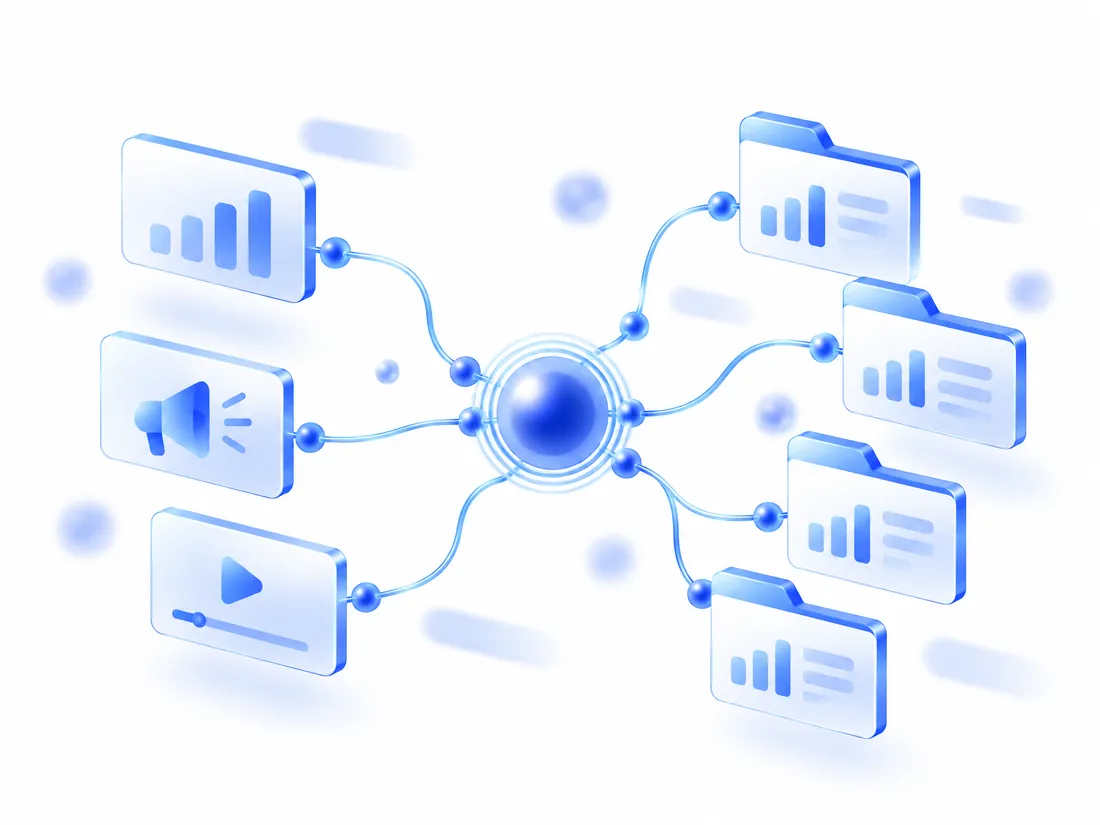
A deterministic pipeline that handles the repetitive client work. The AI reads, extracts and drafts, the logic does the maths and routing, and a person approves anything that touches money or a client.
We turn inconsistent client workbooks into a machine-readable export, roll them into one master tracker, and generate weekly invoice drafts, with a human approval gate that never auto-posts to accounting.
Whatever format your vendors send, spreadsheets, PDFs, photos or ZIP folders, gets read by AI, de-duplicated, matched against your canonical campaign list, and merged into your reporting warehouse. Anything the system is not confident about is quarantined for a person to check.
Client-facing narrative is generated per client and per dashboard section and bound to whatever date range the client picks, so the story on the page always matches the chart above it.
Search-term cleanup, RSA pinning recommendations, and audience and creative-fatigue flags, pulled from your ad platforms and your warehouse and delivered as a formatted action list.
Planned spend reconciled against actual spend from vendor PDFs and your own figures, with variances flagged instead of buried in a stack of documents.
Client, campaign and billing data kept current across your CRM and reporting stack, so account leads are not working from a record that is a week out of date.
For Engage Media, a media-buying agency, monthly invoicing across 35 client workbooks went from three days of manual work to a 30-minute review, with a human approval gate that never auto-posts to accounting. It is one of four connected systems we built for the same agency, all live.
Across all four the same rule holds: the AI reads, extracts and drafts, deterministic logic does the maths, routing and thresholds, and a person approves anything that touches money or goes out to a client.
A four-layer FinOps system took monthly invoicing across 35 client workbooks from three days to about 30 minutes of review. Read the FinOps case study.
An n8n pipeline reads and validates data from around 20 vendors sending inconsistent formats, quarantining anything uncertain before it reaches a client dashboard. Read the vendor pipeline case study.
Dashboard commentary for more than 26 clients now writes itself and stays correct for any date range a client selects. Read the AI reporting case study.
A weekly engine pulls the Google Ads API, the Meta Graph API and the warehouse, runs three analyses, and emails the team a specific action list, with a non-blocking error log so one platform failing never kills the run. Read the ad-ops case study.
n8n orchestrates, Gemini, Claude or GPT read and draft, and the pipeline connects your ad platforms, warehouse, dashboards and sheets.
 n8n
n8n
 Gemini
 Claude
 GPT
GPT
 BigQuery
 Google Sheets
 Looker Studio
 HubSpot
 Pipedrive
 Go High Level
The four systems described here were built for a media-buying agency, but the same pattern (AI reads inconsistent inputs, deterministic logic handles the maths and routing, a person approves anything client-facing) applies to any agency juggling multiple clients: creative, PR, recruitment or marketing agencies with the same invoicing and reporting overhead. We scope the specifics to your actual stack in the free audit.
No. In the systems we built for agency work, the AI extracts, reads and drafts, but a person signs off before an invoice reaches accounting, and the ad-ops engine emails a list of recommended changes for the team to make rather than making them. Money and client trust are exactly where you do not want a model making the call unsupervised.
That is the normal starting point, not a blocker. The vendor-data pipeline we built handles Excel files, CSVs, PDF screenshots and even ZIP folders of photos, reads each one, and quarantines anything the system is not confident about for a person to check.
By generating commentary as structured data instead of a fixed block of text: one short narrative per client, per dashboard section, per date range, so the reporting tool looks up the right narrative instead of showing what was typed last month. It stays correct whichever window the client picks.
It depends on scope, but we favour a phased rollout: the highest-friction process first, usually invoicing or vendor-data ingestion, live before we touch the rest. The invoicing system, the vendor pipeline, the reporting system and the ad-ops engine described here were each built and shipped as their own project.
Not ready to talk yet? Get a free written automation audit: three automations worth building for your business, with rough hours on each. No call. Request your audit.
Book a free audit. We will map where your invoicing, vendor data and reporting eat the week, then show you exactly what to automate first. Confidential and obligation-free.
Book My Free Audit bastien@otimizagency.com